Winter Boiler Pressure Loss in Livingston: Why It Happens & What to Do
Is your boiler losing pressure this winter in Livingston or West Lothian? We explain the common causes and what to do safely. Call us on 07930 555002.

Why your boiler can lose pressure in winter
A pressure gauge sitting lower than it should be is a common reason for a boiler locking out during a cold snap in Livingston and across West Lothian. One minute the heating is running fine; the next, the boiler has cut out and the house is getting cold. In many cases there is a straightforward explanation.
This guide explains what boiler pressure means, why it can drop in winter, what you can safely check yourself, and when you need a Gas Safe registered engineer. It mainly covers combi boilers. You can read about our domestic gas services for boilers.
What the pressure gauge is telling you
Most combi boilers have a pressure gauge on the front. There is a normal operating range for your boiler, usually marked on the gauge or given in your manual, and it varies by make and model. Pressure typically rises a little when the heating is running and the water is hot, which is normal.
If the pressure drops below the minimum shown for your boiler, many boilers will cut out automatically. That is a safety feature, not a fault in itself. The fault is whatever is causing the pressure to fall in the first place. If it rises too high, a pressure relief valve may release water.
Check your boiler manual for the correct range for your boiler rather than relying on general figures.
Common reasons a boiler loses pressure in winter
Cold weather does not directly make a boiler lose pressure, but it can make existing problems more noticeable. Possible causes include the following.
A small leak somewhere in the system
Even a tiny drip from a radiator valve, a pipe joint behind a wall or under a floor, or a fitting near the boiler can cause pressure to drop steadily over days or weeks. You may not see an obvious puddle, because the leak may be very slow or in a place that is hard to spot. If pressure keeps dropping and you cannot find anything obvious, the leak needs tracing properly.
A faulty expansion vessel
Inside the boiler, or sometimes mounted separately, there is an expansion vessel that absorbs the increase in water volume as the system heats up. If it loses its charge, the pressure relief valve can open to release the excess pressure instead, and you lose water from the system. This is a repair for a Gas Safe registered engineer. You cannot safely diagnose or fix it yourself.
The pressure relief valve itself
If the valve is weeping or has opened and released water, pressure will drop. There is often a small pipe running to an outside wall where this water exits. In winter, check whether it has been dripping. This is not a DIY fix.
Air in the system
Radiators that are cold at the top and warm at the bottom may have air trapped in them. Bleeding a radiator releases that air, and system pressure will drop slightly when you do. You then top up via the filling loop. This is one of the few things you can safely do yourself.
A frozen condensate pipe
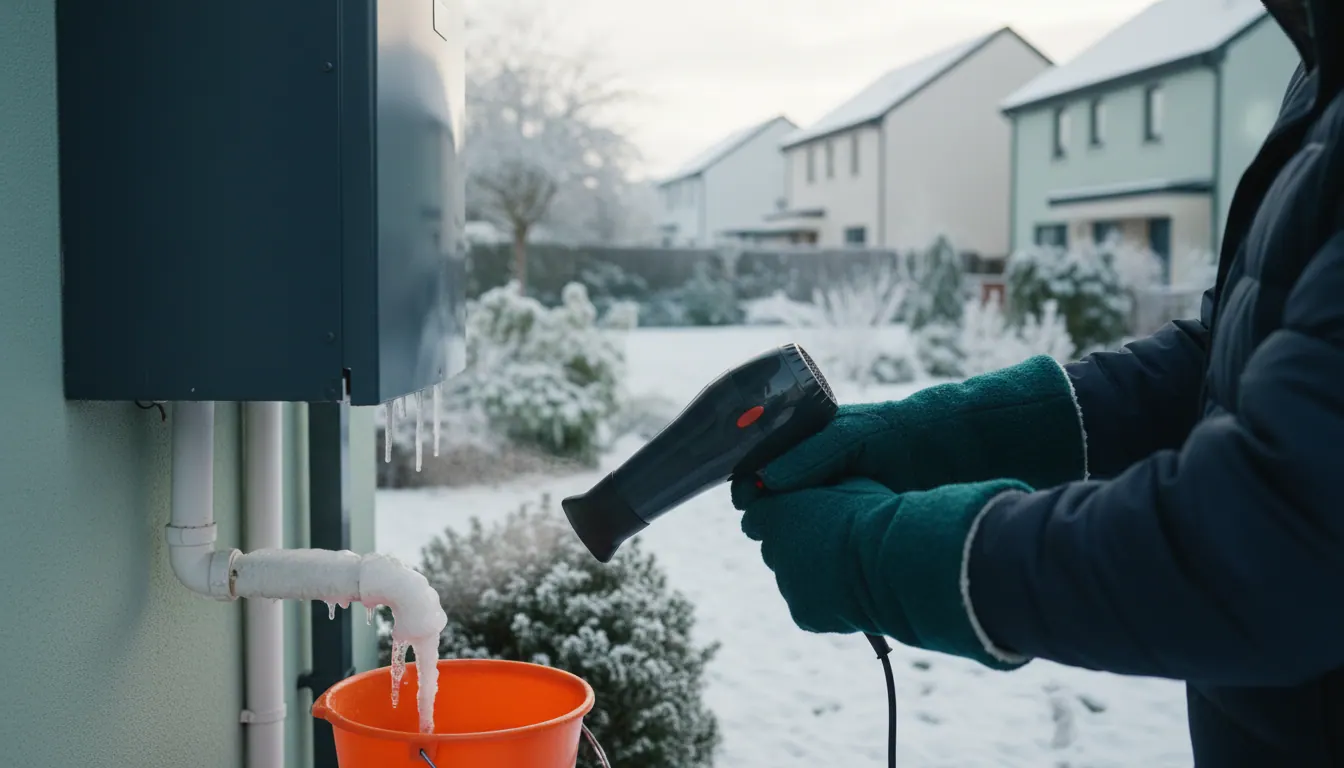
This one is specific to winter in Scotland. Condensing boilers have a plastic pipe that carries waste water outside. In a cold snap it can freeze solid and cause the boiler to shut down. The symptoms can look similar to a pressure problem but are actually a blockage. If a hard frost has just arrived and your boiler suddenly stops, check this first. We explain how in Frozen condensate pipe: how to thaw it and prevent it happening again.
What you can safely do yourself
Keep it simple and keep it safe. Here is what a homeowner can reasonably do before getting in touch.
Check for visible leaks. Look around all visible radiators, valves, the boiler itself and any pipework under sinks or in the airing cupboard. A small damp patch or a white limescale stain around a joint is a clue.
Bleed your radiators. If radiators are cold at the top, bleed them with a radiator key and have a cloth ready. Then check the pressure gauge.
Top up via the filling loop. Most combi boilers have a filling loop, either a flexible braided hose with two valves or a built-in keyway. Follow your boiler manual exactly: open the valves slowly, watch the gauge rise into the normal range shown for your boiler, then close them. Never leave the loop connected permanently. If you are not sure, get in touch and we can talk you through it.
Do not go beyond this. Do not remove the boiler casing. Do not try to adjust the expansion vessel. Do not attempt to repair any gas component. If you smell gas at any point, stop immediately. Do not use any switches or electrical items. Open windows and doors, turn off the gas at the meter if it is safe to do so, get everyone out and call the National Gas Emergency Service on 0800 111 999.
When to call a Gas Safe registered engineer
If the pressure keeps dropping after you top it up, there is an underlying problem that needs a proper diagnosis. Get in touch if:
- The boiler needs topping up repeatedly
- You cannot find any visible leak but pressure keeps falling
- The pressure relief pipe outside is dripping
- The boiler is making unusual noises alongside the pressure loss
- You have topped up and bled radiators and nothing has changed
Work on gas appliances must only be carried out by a Gas Safe registered engineer. That is a legal requirement in the UK, and it protects you and your home. One 4 All Solutions says all its gas work is carried out by Gas Safe registered engineers. Read more about us.
Frequently asked questions
Why isn't my boiler holding pressure even after I top it up? If you are topping up regularly and the pressure keeps dropping, something is losing water. It could be a slow leak in the pipework or radiators, a faulty expansion vessel or a pressure relief valve that is releasing water. Topping up is only ever a short-term measure, and a Gas Safe registered engineer needs to find the root cause.
Does boiler pressure actually drop in cold weather? Cold weather does not directly cause pressure loss on its own, but a frozen condensate pipe can make a boiler shut down in a way that looks pressure-related. Cold conditions can also make small leaks more noticeable because the system works harder. If the problem only started when the temperature fell, check the condensate pipe first.
Is it dangerous if my boiler keeps losing pressure? It is not immediately dangerous in the way a gas leak is, but it should not be ignored. Running a boiler repeatedly on low pressure can cause damage over time, and the underlying cause needs fixing. If you ever smell gas, leave the house, do not use switches and call 0800 111 999 straight away.
Get the right help
Boiler pressure problems are frustrating in a West Lothian winter. We cover Livingston and across West Lothian, take bookings Monday to Friday, 8am to 4pm, and have an out-of-hours emergency callout available.
If your boiler is losing pressure and you want it properly diagnosed, get in touch with us. You can call or WhatsApp 07930 555002, email info@one4allsolutions.co.uk or use our contact form to request a callback.
“Phoned One4allsolutions to help with a gas problem , they were able to fix the very next day . Brilliant service would definitely use again and not hesitate to recommend .”